How To Quit Everything and Make Stained Glass
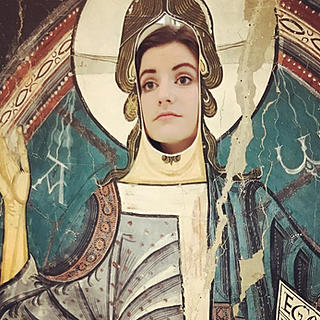
Breaking and shattering with purpose.

The first time I soldered, I grabbed the soldering iron by the iron, not the handle. Yes, it was plugged in and turned on.
Whatever version of autism I have — which has now been officially diagnosed, but may soon categorize itself into some other neurodivergence due to its apparent relatability — impacts my processing speed. This was noted by the psychiatrist in my recent assessment, and it echoes years of (less diagnostic) sentiment that I'm suuuper smart… but a bit slow.
"Like a cargo ship," my mom would say. "Just takes you a while to turn, but then you're off in that direction and nothing can stop you." It took me a while to process that I was holding 400 degrees of metal in my human meat hands.
When I finally did notice, I dropped the iron like a hot potato (which would have been preferable). I peeled away the rubber gloves, which had melted at the points of contact and had otherwise conducted the heat down my fingers in a way that burned less seriously -and therefore more painfully- than the iron itself had. I made a joke I don't remember, to assure everyone else in the introductory stained glass class that I was fine, then rushed to the restroom to run my shaking fingers under cold water.
You know what's weird, though? I didn't cry.
I always cry. I could cry right now just thinking about how I always cry. I'm a nervous wreck, always thinking about what could go wrong, how I could mess up, how I could look stupid, how my loved ones and I are nothing but killable NPCs in a world built for and by destructive, unserious "antiheroes".
I've got too much adrenaline in my system. I'm like a little bunny, constantly twitching my ears for danger, ready to stomp the ground and gather my people into an underground hole I've decorated meticulously with irreverent art, shiny things, comfy things, and treasured memories. My grandmother was the same way, so I know the nerves and visual thinking are inherited.

But when the worst did happen — I'd fucked up and seriously hurt myself, on my very first project, no less — I was surprised to find that I wasn't feeling fear, dread, or shame. Instead, I was flooded with a strange sense of …accomplishment?
Angry welts started to form on the thumb, fore, and middle finger of my dominant hand, but it didn't matter. I felt incredible.
I had wanted to make stained glass for years.
It was the fantasy I escaped to when I was overwhelmed at work, when I was having relationship issues, when I was feeling self-conscious. For a long time, it was such a quiet message in the back of my head that it was almost subliminal, so I didn't realize it was the only constant:
I just want to quit everything and make stained glass.
Everything would be better if I learned how to make stained glass.
I bet that blank wall I can't afford to put art on yet would look so much nicer through some colored glass.
Mmmm…. solder lines.
As a white American descendant of European immigrants, I’ve never had a cultural or ancestral connection to any land. As a pansexual woman, I'd also never been sure if I saw myself with a man, a woman, or single. I’ve always gone back and forth on having kids, on what my career should be, where and how I want to live... My neurodivergence makes me so used to physical discomfort and detailed nuance that a sense of "self" has always felt elusive.
Being of this generation has meant consuming so much information from the little screen in my pocket, contemplating so many different lives, that my "self" has become fractured — or perhaps multifaceted? — in a way humans probably won't understand until our own descendants have had an opportunity to get some distance and examine our accounts of when we first got a taste of being everything, everywhere, all at once.
So when my silly, quick-witted, "yes, and-" improv-minded boyfriend asked me recently — with deep frustration and contextual poignancy — "What do you want?" (and I’m pretty sure he meant- "What future do you imagine for yourself that requires setting goals and making sacrifices?"), all I could say for certain was:
"To make beautiful things".
And that's genuinely it.
If forced to specify, I want my hands to be moving, pressure applied, forms to be taking other forms, light refracting, chemicals reacting. I want something to exist that didn't exist before I had the idea (or at least this particular version of the idea) — to prove that I was here, to have a sense of control that doesn't inflict control on anyone else. I want a room of my own that people can come to when I invite them.
I want tools. I want supplies. I want sustainability. And when I say "That's it," what I mean is — what comes into my life from there: friends and family and location and money, doesn't have to be terribly curated, you know? I think I'd be happy to be surprised by the shape of it.
Spiders weave their webs anywhere, right? They're pretty famous for it. Whatever sticks, sticks, whether they mean for it to or not. Sometimes, this is what sustains them. Sometimes, it weighs them down. But they get to just focus on the weaving — on the obsessive, monotropic, locked-in weaving.

Over the next couple of weeks, the burns on my fingers bubbled and shot lightning up my hands and arms at the slightest touch or movement. Typing on a keyboard for my day job as a tech analyst sucked. But it was a regular reminder that I was doing the thing.
"How'd you burn your fingers?" someone would say, concerned.
"I was making stained glass," I'd respond, grinning. My little studio was coming along too.

My fingers healed faster than I had expected them to, and I was back at it before then, thinking about how, when my mom was my age, she'd gone back to her medical residency almost immediately after undergoing major surgery on her neck - before she'd had tactile feeling back in her fingers. She did this because, a few years before her injury, she'd had three kids in three years, and her astute husband had noticed a certain discomfort, a certain longing that was palpable.
When he poignantly asked her, "What do you want?" …she realized the answer was, "Medical school." And so they'd worked it out. He reduced his hours to stay home and take care of the kids, they enlisted the help of her parents, and my mom enrolled in medical school. She'd gotten all the way to residency before a neck injury laid her flat-out. I distinctly remember the buzzing of the fluorescent lights in her windowless hospital room when she came out of surgery. The way they turned the antiseptic on her stitched-up throat a sickly yellow…
But she healed. And then she went back and finished her residency.
When I went back to my stained glass class at NatDametto Vitrales, I was very careful to look away from my project and directly at the soldering iron before I picked it up for another sizzling, satisfying pass with the lead-that-was-actually-tin-now-a-days-for-reasons-relating-to-sickness-and-madness-and-increased-knowledge.
The thickness of my lines was inconsistent. There were bumps in the tin. I had regrets about some of my color choices. But finished pieces had such a satisfying weight to them — not the sort of thing my generation has increasingly become so accustomed to with mass-manufacturing. Forget particle board and plastic and synthetics. With stained glass, there was no air of cut corners, ironically. It had the heft of handcraftedness and demanded delicate handling. Variations and imperfections in the glass were the result of someone's breath and careful movements. I could hold my hard work up to the light and see it glow.
I’d recently seen an image of a rabbit and a spider online that I couldn’t get out of my head. (A reverse Google image search said it might be the work of Steven Bradshaw, but I couldn’t find the exact piece in his archives and his similar rabbit art looks just different enough for me to doubt. If it turns out to be someone different, I’ll of course give them full credit.)
I found some printer paper and got to work on hand-drawing a pattern based on the concept:

But stained glass doesn't adhere to typical line art rules. You have to be conscious of the structure and where glass tends to break, and I could already tell I was creating a practical mess for myself. So I reached out for advice. Suggestions from an online stained glass forum were helpful:
“Extend the tail to eliminate those awkward background slivers that'll be hard to cut."
"Anywhere you can combine a leadline from the subject with a leadline from the background, find a way to do that.”
“Look at the shapes of their bodies. Do they help define the anatomy in curable, pleasing shapes?”
“Maybe some dichroic bevel pieces for the spider’s body? That way, it would project multiple colors from different shades of light?”
“Needs a second foot.”
I listened, adjusted, and refined.

When I brought it in to my instructor, Nat, she warned me that this was going to take much longer than I expected. "Ambitious but doable," she said. "I just want you to know what you're getting yourself into."
I respectfully ignored her, of course, because I couldn't have conceived of what she meant at the time. I was a cargo ship, already traveling in a certain direction. So she helped me to plug the design into a drawing app, incorporate a more whimsical frame, and select my colors:

Every Saturday for the next four months, in four-hour sessions, I returned to Nat's studio to print the design backwards onto sticker paper, number the piece, cut it out, stick it onto a carefully selected section of glass, cut the glass piece one single not-too-curvy edge at a time, pin it in place, grind it into exactly the intended shape, clean it from every angle so copper foil would stick, foil the edge, flux and solder a line (being careful to grab the iron by the handle), solder that line on the other side (by the handle!), clean again, patina, oxidize…
And then do it again, 129 more times.
It was SO much more work than I had anticipated, and I loved every. single. minute of it.
It was Nat's idea to overlay the spider rather than cut it into the pattern itself. I wasn't entirely sure what she meant at first. Would it be glued to the background glass? Was there a way to solder it on? Listen, I have a tattoo that went wrong from trusting an artist to know better than what my gut was telling me, so it was truly anxiety-inducing to trust the process without fully understanding it.
Nat, of course, had no idea that I was berating myself, bracing for the regret I'd feel that I'd let my vision be steamrolled. But when I eventually understood that she intended for the spider to be hung from a chain, I thought it was genius — especially when I realized that it could now be made of literally anything I wanted, which put the creative decision-making back in my hands.
I liked the beetle-like colors and the way the light hit Labradorite.
When I’d looked up the symbolism, there were mentions of transformation, inner wisdom, willpower, self-worth, and clear communication. For the 24 hours before I incorporated the two tear-drop-shaped stones into the piece, I'd slipped them into my pocket and fiddled with them constantly, never letting them lose the warmth of my hands until they were too hot to handle from soldering.
And then the piece was patina-ed, silver lines turned black like magic, pliers were used to attach the spider to the chain and the chain to the piece…
And then it was done.
There's a quote that's followed me around most of my life. Something my 7th grade Social Studies teacher once told my parents:
"Katlyn is a poor steward of her imagination".
And in the context of any and all windowless spaces that light themselves via god-awful fluorescent strips that shiver and buzz like angry cicadas during a biblical plague (places like schools, hospitals, underground car parks, and government buildings) — yes. My imagination has, necessarily, left the building. In that context, a burn, a cut, a headache, an unkind word is debilitating.
But put me in some warm light, give me something to do with my hands, give me even a little space with which to work (maybe leave an old door out on the street that I can drag home and turn into a work table)… and I glow.

Here's what people are saying about this article over on Medium:
"She grabbed a 400-degree soldering iron bare-handed on her first day and felt accomplished.
That's not a red flag. That's a calling. Thanks for sharing." - Simi Amos
"Your article beautifully inspires creativity and courage, showing how quitting routine life can open space for art, healing, and discovering deeper personal purpose." - Rajesh Poovathum Kadavil
"Everything you could want in an article. Everything!
It also helped that two hours before I read it I had just told my friend the exact same thing. Enough with the writing. I just want to create stain glass art or pebble art.
Well, after reading how demanding this craft is, I think I'll go with my pebble art instead.
Hopefully pics will follow--yours and mine." - Ruchama
"I have zero desire to make stained glass. yet this resonates so much. I love this deep dive into the small triumphs and discoveries that come with a creative practice, and how they can bring great purpose to our lives. Thank you for the inspiration!" - Anna M. Clark
"My first thought, as a person who spent a good ten years soldering wires together and putting components into circuit boards is that, and I quote: " Holy crap that had to hurt." - Kelly Davis


Comments